
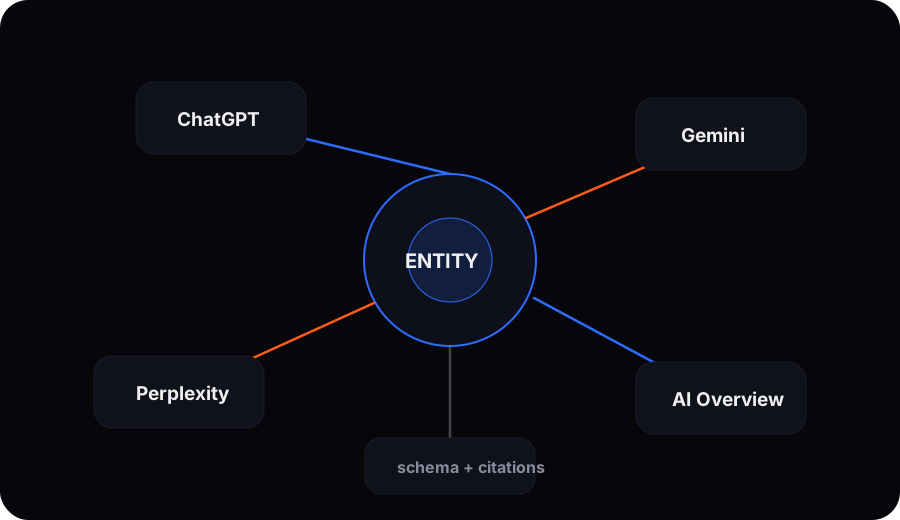
If you have spent years thinking about Google rankings, a new question is now just as important: does AI mention your brand? When someone asks ChatGPT, Perplexity, or Google's Gemini a question, they receive a single, synthesised answer, and the brands cited in that answer win the attention. Getting into that answer is the job of GEO, or Generative Engine Optimisation.
GEO, defined
Generative Engine Optimisation (GEO) is the practice of structuring and writing content so that AI answer engines cite your brand as a source within their generated responses. Where SEO optimises for ranked links on a search results page, GEO optimises for inclusion in the answer an AI gives directly to the user.
Why GEO matters now
Search behaviour is shifting from a list of ten blue links to a conversational answer. A growing share of queries are now resolved inside an AI response, with no click to any website. In that world, the metric that matters is not your ranking position, it is whether you are cited. Brands that earn citations become the default recommendation; brands that do not simply disappear from the conversation.
- Citations are the new rankings. Being named and linked in an AI answer is the modern position one.
- Entities beat keywords. AI models reason about who you are, what you do, and where you operate, not keyword density.
- Early movers win. GEO is still emerging, so optimising now establishes you as a trusted source before competitors react.
How GEO differs from SEO
SEO and GEO share a foundation but aim at different targets. SEO improves your visibility in the ranked results, the goal is a click. GEO improves your visibility inside the synthesised answer, the goal is a citation. The encouraging news for UK businesses is that the same entity-rich, well-structured, factual content powers both, which is why Kay & Co. delivers SEO and GEO as a single strategy.
GEO is to AI answers what SEO is to search rankings, and the brands that master both become impossible to ignore.
How to get cited by ChatGPT, Perplexity, and Gemini
AI engines favour content that is clearly structured, factually precise, and entity-rich. In practice that means:
- Define your entities explicitly, your name, services, location, and expertise, reinforced with schema markup.
- Answer real questions directly in a structure models can extract and quote.
- Add structured data, FAQ, Article, Organization, and Speakable schema help engines parse and cite you.
- Write in a citation-friendly style, factual, sourced, and confident prose earns attribution.
- Build authority across the sources these models already trust.
The bottom line
GEO is not a replacement for SEO, it is the next layer of visibility. As search becomes an answer rather than a list, the brands that invest in being cited will own the most valuable real estate in discovery. Kay & Co. is a UK SEO and GEO optimisation consultancy built precisely for this shift.
Frequently asked questions
GEO (Generative Engine Optimisation) is the practice of structuring content so AI answer engines like ChatGPT, Perplexity, and Gemini cite your brand as a source in their answers.
No. GEO complements SEO. The same entity-rich, well-structured content can rank on Google and be cited inside AI answers, so the two work best together.
Start by defining your entities clearly, answering real questions directly, adding structured data, and writing factual, citation-friendly content. Kay & Co. offers a GEO audit to map the fastest wins.