
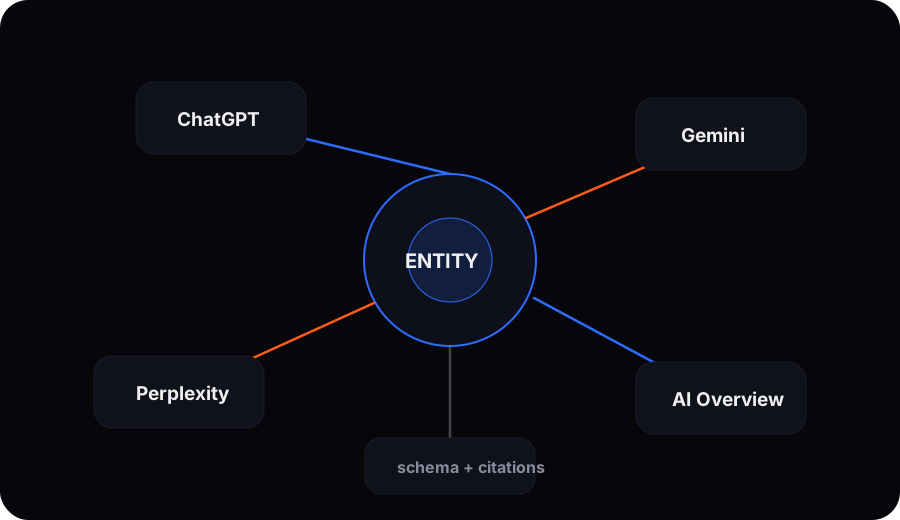
The systems answering your customers' questions, ChatGPT, Gemini, Claude, Perplexity, are all powered by large language models (LLMs). Getting these models to understand and cite your brand is a discipline of its own: LLM SEO. This guide explains how LLMs decide what to surface, and how UK businesses can influence it.
What is LLM SEO?
LLM SEO is the practice of optimising content so large language models understand, trust, and cite your brand when generating answers. It's closely related to Generative Engine Optimisation and AI SEO, but it focuses specifically on how the underlying models perceive your brand, both from their training data and from the live content they retrieve at answer time.
How LLMs decide what to cite
Large language models work in two relevant ways. They have parametric knowledge baked in from training, and many now use retrieval to pull live web content into an answer. In both cases, they favour information that is:
- Clearly written, unambiguous, well-organised, and easy to parse.
- Factually consistent, the same facts stated the same way across the web build confidence.
- Authoritative, frequently referenced by other trusted sources.
- Entity-anchored, tied to clearly defined people, brands, and concepts.
You can't rewrite a model's training data, but you can shape what it learns about you next, and what it retrieves right now.
Can you actually optimise for an LLM?
Yes, within limits, and meaningfully. You cannot directly edit a model's weights, but you can control the signals that shape its perception of your brand: how clearly you define your entities, how consistently your facts appear, how well-structured your content is, and how broadly you're cited across authoritative sources. Over time, these compound into stronger, more frequent citations.
How to do LLM SEO
- Establish a consistent entity. State who you are, what you do, and where, the same way everywhere, site, schema, profiles, and citations.
- Write unambiguous, factual content. Models reward clarity and consistency; they penalise contradiction.
- Structure for machines. Clean headings, concise answers, lists, and schema make content easy to extract.
- Earn authoritative mentions. The more trusted sources reference you, the more confidently models cite you.
- Keep facts current. Update key pages so retrieval surfaces accurate, recent information.
LLM SEO in the bigger picture
LLM SEO sits alongside Answer Engine Optimisation and Google AI Overviews optimisation under the broader goal of AI visibility. Kay & Co. ties them together so one content strategy makes your UK brand the answer across every model and engine.
Frequently asked questions
LLM SEO is the practice of optimising content so large language models, the AI behind ChatGPT, Gemini, Claude, and Perplexity, understand, trust, and cite your brand when generating answers. It is a key part of Generative Engine Optimisation.
LLMs draw on training data and, for live answers, retrieved web content. They favour clearly written, factually consistent, well-structured information from sources that appear authoritative and are frequently referenced across the web.
Yes. While you cannot edit a model's training data, you can shape how it perceives and retrieves your brand: clear entities, consistent facts, strong structure, and broad authoritative presence all measurably improve citation likelihood.