
Healthcare digital marketing
Healthcare marketing agency for your practice
A healthcare marketing agency can help clinics and care providers make their services easier to find and understand. Kay & Co. brings search, local information, content and campaigns together around a specific service and a clear next step. We start with the problem you can describe, then agree the work that fits it.
A useful first project might improve one service page and its enquiry route. It might instead review local listings, plan a campaign or clarify what happens after someone contacts your team. The right choice depends on your practice, its capacity and the information you already have.
Start with a decision, not a list of channels
Before choosing a channel, name the service you want to make easier to find. Identify the people who need it, the locations you serve and the capacity you have to respond. A campaign for appointments makes little sense if the team cannot offer them or answer the resulting enquiries.
Next, follow the route a person takes. Can they find a relevant page? Does it explain the service, location and next step? Does the contact method reach someone who can respond? Each question points towards a different kind of work.
Bring what you know to a first conversation. A page address, recurring reception questions, a recent listing issue or a description of a broken handover can be enough to start. If the cause is unclear, the first piece of work may be a review rather than a campaign. The result should be a written decision about what to do next and what still needs checking.
Choose a starting point
- People cannot find the service: review the service page, relevant search results and local information before deciding whether search work or a campaign is appropriate.
- People find the page but ask the same basic questions: review its explanation, location, costs where available and next step with the people who know the service.
- Enquiries arrive but do not reach the right team: follow the form or phone route and agree who receives, assigns and checks messages.
- Several suppliers are working separately: map the work and approvals before asking another supplier to make changes.
These are starting questions, not diagnoses. A proposal should explain which evidence was available, what remains unknown and what the agreed project will investigate.
What might a healthcare marketing agency project include?
Use the examples below as questions for a proposal, not a list of standard Kay & Co. services. Ask which activities and outputs are available for your project, who would perform them and how completion would be checked. A plan, a draft and a published change are different deliverables. Name the one you expect to receive.
Search
Start with the service people are trying to find and the page that best explains it. A search brief can identify the page to improve, the questions it should answer and useful links to it. The work may include a content outline, proposed page changes or a review of technical barriers. State whether implementation is included and who can approve factual details.
A page rewrite is not automatically a full technical audit. If the site has access, indexing or performance problems, name those checks separately. Agree how findings will be recorded and which supplier can make any changes. See our healthcare SEO services for a more focused discussion of search work.
Local maps and listings
People may see a practice name, address, opening information or contact number before they reach the website. A local information review can list the locations and profiles in scope, identify details that need checking and show where each profile sends visitors.
Confirm who owns each account and who has authority to publish corrections. A supplier may be able to prepare a change while the practice or another account owner must approve it. Check website and listing information together, including the destination of appointment and telephone links. Do not assume that a proposed correction has appeared until the owner has checked it.
Useful content
Choose a question that affects a person's understanding of the service. The output could be an outline, a draft service page, a revision to existing information or a short content plan. Agree whether the work includes research, writing, design, publication and later updates. Each stage may involve different people.
The practice should identify who checks the accuracy of its service information and who can approve it. The brief should identify existing material that may be reused and any information that is not yet available. A draft should not turn an unconfirmed detail into a fact. Keep an open question visible until the appropriate person supplies or checks the answer.
Campaigns
A campaign needs an audience, a message, a destination and a next step. For example, a brief could pair a message about one service with a page that explains that service and shows how to enquire. The page should be ready to support the message before traffic is directed to it.
For example, a campaign about assessment appointments might send visitors to the general homepage. A more direct route would lead to the relevant assessment page, where the practice has checked the appointment details and enquiry link. On a phone, check that the campaign opens the intended page and that the enquiry link reaches the agreed contact route. Record the expected and actual destinations so an error can be assigned for correction.
Specify whether the work covers planning, creative material, page changes, campaign setup, monitoring or ongoing management. These activities are not interchangeable. Agree who controls the relevant accounts, who approves the content and budget, and what happens when a campaign ends. If a third party manages a channel, identify how work will be handed to them.
Give each email a clear purpose and a defined audience. A scoped output might be a message outline or draft, the destination it links to and a record of the person who will approve it. If sending is included, agree the system, list responsibility and checks before any message goes out.
The team responsible for the practice's permissions and policies should confirm the audience and sending arrangements. A marketing draft alone does not establish whether a list is suitable for a particular message. Keep contact data within the systems and access arrangements agreed for the work.
Follow the whole journey
A person may discover a practice through search, a local map, useful content, a campaign or an email. Each route should lead to information that helps them decide what to do. From there, the next step may be a phone call or an enquiry to the team.
The route is only useful if the handover works. A page can have a clear form while messages arrive in an unattended inbox. A listing can show a telephone number that reaches the wrong location. A campaign can describe a service that the destination page does not explain. The project should name the route being checked and the people who can confirm each part.
Accessible static summary of the journey: search, local maps, useful content, campaigns and email can lead to a practice page. That page should explain the relevant service and offer a suitable phone or enquiry route. The practice team then needs a clear way to receive and respond to the contact. This is an illustrative route, not live patient data.
From a first impression
to a real conversation.
People exploring care
An illustrative journey, not live patient data.
your care and take the next step.
Explore a route. See how it joins the whole.
The connection matters
Every route should lead somewhere useful.
A search, a local listing, something worth reading or a relevant campaign. Each should help someone understand your practice and choose their next step.
Discuss your marketing priorities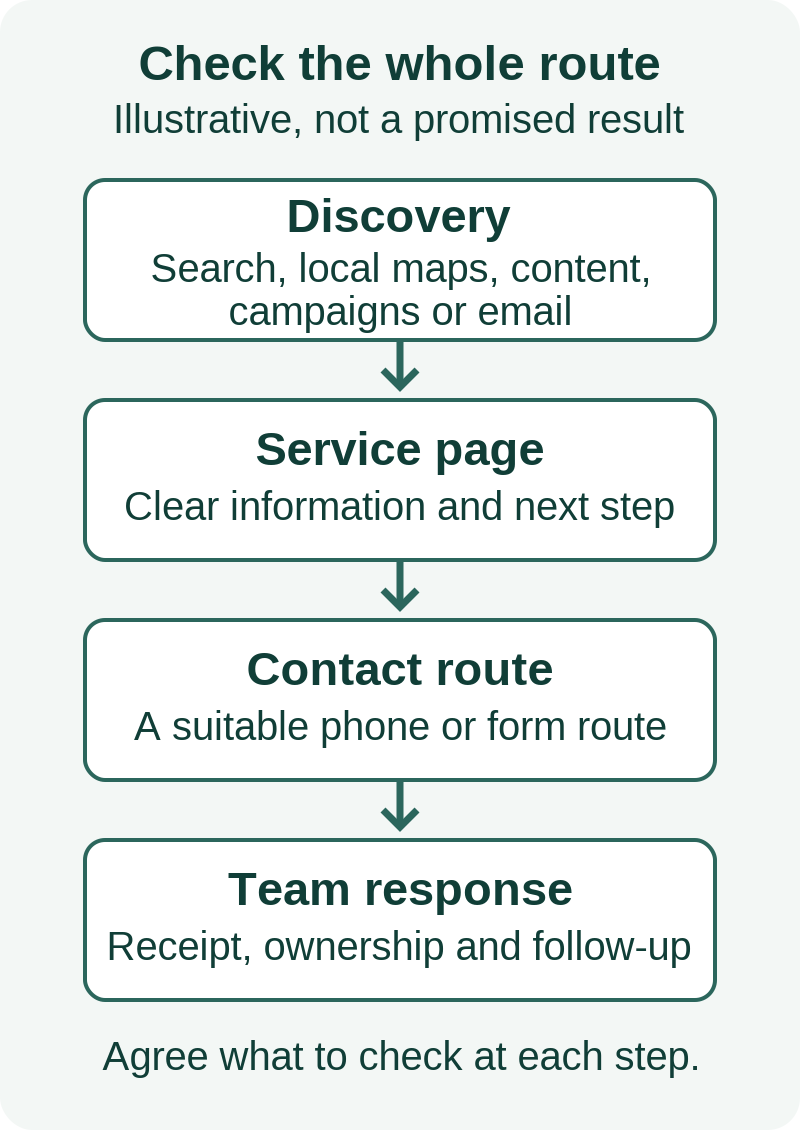
Check a route before adding another
Choose one real task and follow it from the first public touchpoint to the receiving team. Record the page or profile visited, the action offered and the handover point. Use an authorised test arrangement agreed with the practice. Avoid entering personal health details into a test unless the practice has explicitly established an appropriate method.
Ask the receiving team what they need to identify and handle a message. If the route fails, record what happened, who can investigate and how a correction will be checked. A successful test shows that the agreed test route worked at that time. It does not prove that every future enquiry will be received or answered.
Agree the first project
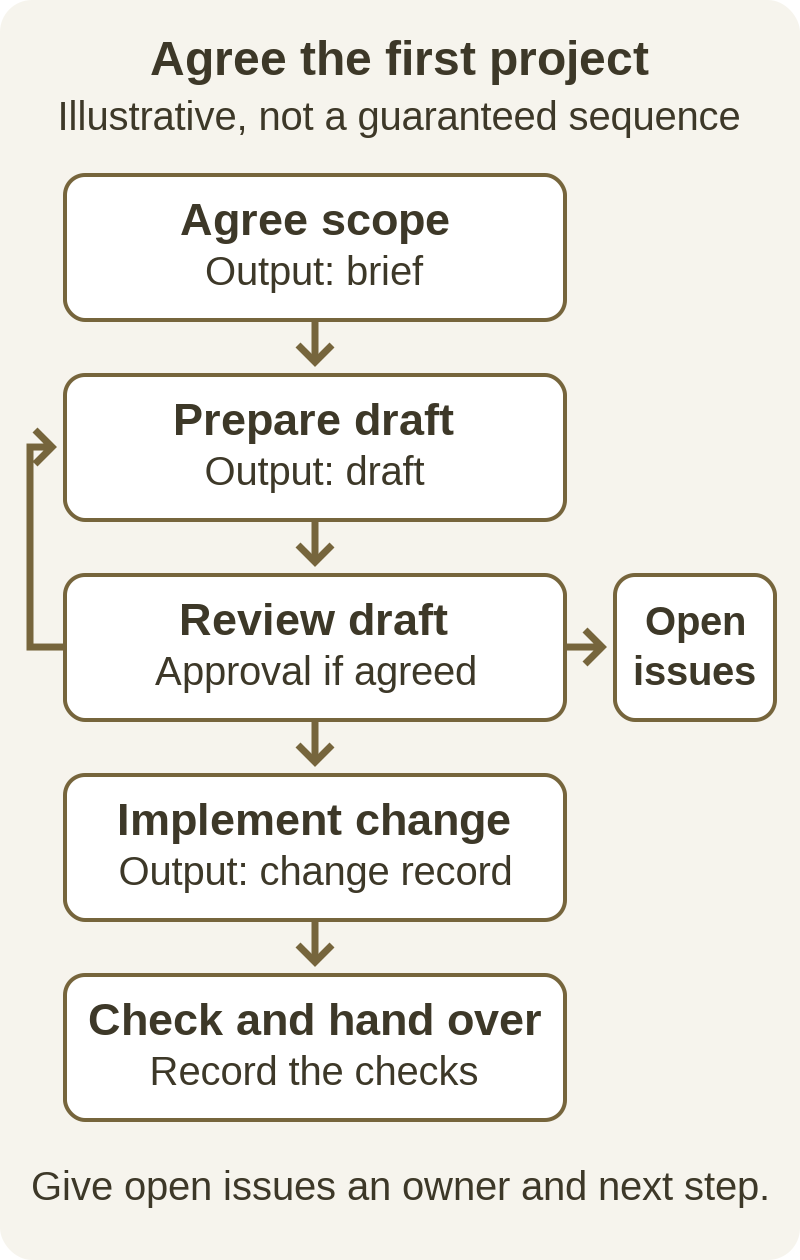
A proposal should turn a broad aim into work that the practice and its suppliers can understand. It should identify the chosen service and audience, the pages or profiles in scope and the problem to investigate. It should also say what is outside the project, especially where a reader might reasonably assume that publication, advertising or technical repairs are included.
Name the outputs
For every output, ask what form it will take. A review might produce an issue list with evidence and priorities. A content task might produce a page outline and one draft. Implementation might produce a published page and a record of the checks performed. If reporting is included, agree the questions the report will answer and the source for each measure.
Describe the acceptance point for each item. For a draft, this could be the practice's factual review and a list of agreed revisions. For a page change, it could be a check of the page, its contact route and the agreed links. An acceptance record should also name unresolved work so that a completed item is not mistaken for a completed programme.
Name the people
Identify a person who can make decisions for the practice, a factual reviewer for service information and an owner for each relevant account or website. The same person may hold more than one role. If an external supplier controls the website, agree how they will receive a brief and report completion.
Kay & Co. can work alongside existing suppliers where the scope and access arrangements allow. The proposal should make clear which work Kay & Co. owns, what remains with the practice and what depends on another supplier. Where responsibility is undecided, record the decision needed rather than assuming someone else will take it.
Agree the review and change process
Set out who receives a draft, how comments are gathered and who resolves conflicting instructions. Agree what happens if new information changes the scope. A request to add another service, location or campaign can affect the work, access needs and cost. Record the change and its implications before treating it as part of the original agreement.
Keep a simple issue list. Include the item, the decision or action required, its owner and its status. This helps the team distinguish work that is ready to publish from work waiting on a fact, supplier or account permission.
A fictional example: one service and one enquiry route
The following example shows how a project could be structured. It is fictional. It is not a client account, a case study or a claim about results.
A practice offers a particular appointment at one location. Reception says that callers often ask whether the appointment is available there. The practice can offer the service, but its page lists several locations without making the distinction clear. The team also wants to understand whether the contact form reaches the right person.
The first decision is to focus on the service page and enquiry route rather than launch a new campaign. The practice supplies the current service and location details. Its named reviewer checks the proposed wording. The website supplier confirms who can change the page and how a test message can be identified.
The agreed outputs are a revised page draft, a list of links and location details to check, and a short test record. The draft states which location offers the appointment and gives the next step. It leaves any unconfirmed fee or availability statement for the practice to resolve. The reviewer returns one set of factual comments before publication.
After approval, the person with website access publishes the change. The team checks the page on a phone and a larger screen, follows the contact link and sends an agreed test. The receiving team confirms the destination and records the outcome. If the message fails, the record names the issue and the person responsible for investigation. The project is not treated as complete simply because the page was published.
The practice can then decide whether a local listing correction or a campaign is worth considering. That later decision would need its own scope and evidence. This example does not predict a change in rankings, enquiries or appointments.
What should your brief include?
A short brief is more useful when it makes decisions possible. It does not need to answer every technical question. Include the information below where you have it, and mark the rest as unknown.
- Service and audience: the appointment or service, the people it is intended to reach and the locations involved.
- Capacity and contact: what the team can currently offer, how people should contact it and who receives the enquiry.
- Problem: what you have observed, where it happens and who noticed it. Include a page or profile address if relevant.
- Existing work: current suppliers, campaigns, content and systems that the project needs to consider.
- Deliverables: the decisions, drafts, changes or reports you want to receive, and whether publication is included.
- Review: who can check service facts, approve material and decide whether the work is ready to go live.
- Dependencies: account access, third-party support, booking systems, content or approvals that may affect progress.
- Completion: the checks that will show whether the agreed work has been delivered and where open issues will be recorded.
If you do not know which service to commission, describe the task and the evidence you have. Our website brief guide can help you organise a wider digital project. A marketing engagement can then be scoped around a specific part of the problem.
Understand the cost and commitment
A meaningful comparison looks beyond a headline fee. Ask what work is included, how many pages or locations are covered and which outputs you will receive. Check whether the proposal includes planning, writing, design, implementation, campaign management or reporting. A lower initial figure may cover a different set of tasks.
Cost can depend on the number of services, locations and pages involved; the condition of existing information; the need for new content or technical work; and the number of suppliers who must contribute. Access delays, third-party changes and additional review rounds can also affect a project. Ask how changes to scope will be priced and approved before extra work begins.
Separate supplier fees from any advertising spend, software subscriptions and external supplier charges. Ask about the length of any ongoing agreement, notice terms, account ownership and what happens at handover. Do not assume that a campaign budget includes management or that management includes website changes. The proposal should make those distinctions visible.
A one-off project and an ongoing programme serve different needs. A first project may establish a page and a working enquiry route. Ongoing work may involve further content, campaign changes or agreed reviews. Choose the commitment that matches the work you need, rather than the longest list of possible activities.
Measure what the work can actually show
Agree the question before choosing a number. If the question is whether people can reach a service page, a page-visit measure may help. If the question is whether the practice receives relevant enquiries, define what an enquiry is and where it is recorded. A visit, a submitted form, a call and an appointment are different events.
For each measure, name the source, period and scope. A useful record might state which service and location are included, whether test messages are excluded, and whether the data is complete. If a phone call cannot be linked reliably to a particular source, say so. Missing information is a limitation, not a zero.
Compare like with like where possible. Changes in opening hours, staffing, service availability, season or other activity may affect the result. A change in a chart alone does not establish its cause. Rankings and enquiry volumes are not guaranteed, and a report cannot establish bookings or clinical outcomes unless suitable evidence exists for those questions.
Agree who will review the information and what action a finding could prompt. For example, a page with visits but repeated basic questions may need clearer information. A form that receives test submissions but notifies the wrong team needs a handover correction. Record the decision and the next check, rather than collecting numbers without an owner.
Working with your existing team and suppliers
Your practice may already have a website agency, an advertising provider, a designer or an internal marketing team. Tell us who manages each relevant account and who can approve changes. If a supplier cannot perform a task or a system does not support it, record the constraint and decide whether an alternative belongs in scope.
Access should match the task. Agree which accounts are needed, who grants access and when it will be reviewed or removed. The practice should know who controls its domain, website, advertising accounts and other important records. The project should not depend on an undocumented personal account or an assumption that access will remain available after the work ends.
Review, handover and next steps
At handover, compare the work with the agreed brief. Record completed checks, the location of approved files, open issues and the owner of each next action. Keep dependencies on another supplier or a later decision visible rather than describing them as complete.
A useful close to a first project may be a decision to stop, maintain the work or commission a further stage. The choice should follow the evidence and the practice's capacity. A plan for the next stage should name its own deliverables and checks.
Frequently asked questions
Do we need every marketing channel?
No. Choose channels around the audience, the service and the problem to solve. A clearer service page or a repaired enquiry route may be more useful than adding a campaign. Agree the reason for each channel in the brief.
Do we need a new website?
Not necessarily. A first project may improve an existing page or contact route. A rebuild needs a reason, such as a structure or editing system that cannot support the practice's current needs. Platform and supplier limits may need investigation before deciding.
Can you work with our current website or marketing supplier?
The scope can identify work for Kay & Co., the practice and existing suppliers. Confirm account access, approval routes and each supplier's responsibilities before implementation. A dependency on another supplier should be named in the proposal.
Who checks information about our services?
The practice should name an appropriate person to check its service facts and approve material. The brief should explain who supplies missing information and how corrections are made. Do not publish an unconfirmed detail as though it has been verified.
How will we know whether the work is complete?
Agree the output and acceptance checks in advance. Depending on the work, these may include an approved draft, a published page, a tested link or a report with defined sources. Record unresolved issues and their owners as part of handover.
Can you guarantee rankings or enquiries?
No. Search visibility and enquiry volumes can be affected by factors outside the agreed work. Reporting should explain what was measured and what it cannot establish. Agree practical checks and review the evidence without treating a target as a guaranteed outcome.
Discuss your priorities
Bring one service, location or enquiry route you want to improve. We can discuss what is known, what needs checking and whether a focused project is a suitable next step. Any work, responsibilities and costs should be agreed in a proposal before it starts.
Plan your project
Useful marketing & search resources
- Healthcare marketing metrics: count useful enquiries
- Patient acquisition for opticians: a practical guide for independent practices
- Healthcare referral marketing: planning professional relationships
- Campaign tracking: a practical guide for healthcare practices