AI risk assessment gives healthcare business owners a way to decide whether a proposed use of AI is sensible before routine use begins. Identify who could be affected, what might go wrong, whether safeguards work and who can decide.
This guide concerns administrative work, not clinical tasks or decisions about individuals. It is a planning exercise, not a data protection impact assessment (DPIA), legal advice or compliance sign-off. If a proposal involves personal information, ask your responsible privacy specialist to decide which assessments and other steps are required before use.
Start an AI risk assessment with one bounded proposal
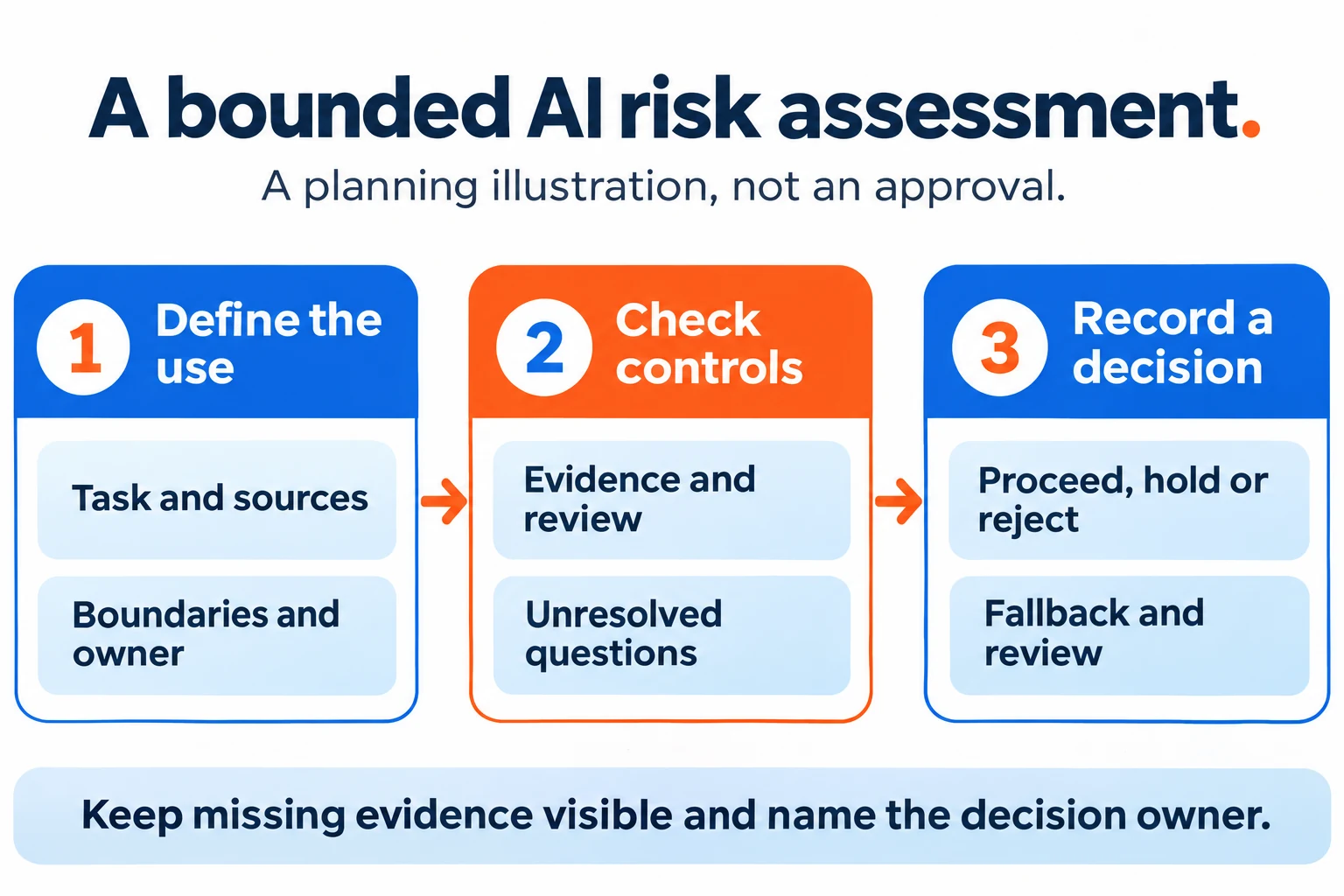
Begin by describing the intended task, the information involved and what the tool will and will not do. Avoid approving a broad statement such as “use AI for procurement”.
For example, a team wants an AI tool to draft a comparison of suppliers' service terms using published information. Staff will check the draft against the original sources. They will not enter personal or confidential information, and the tool will not purchase anything or send messages. A person remains responsible for the comparison and any later decision.
Check whether you are permitted to use public material in the proposed way, whether it is current and whether the tool's terms are acceptable. Public availability does not automatically grant a licence.
Your existing AI policy template can set the wider permissions for staff. This assessment answers a narrower question: should this particular use be approved under those permissions?
Identify people, failures and consequences
Write down who could be affected, including people outside the team. In the supplier example, an inaccurate comparison could affect the owner making a purchasing decision, colleagues who depend on the service and suppliers whose terms are misrepresented.
For each meaningful risk, record three things:
- Failure: What specifically could happen? For example, the tool might omit an exclusion or combine terms from different supplier pages.
- Consequence: What could follow? A decision-maker might choose a service on a false understanding of its scope or cost.
- Evidence: What do you know about the tool, source material and proposed checks? Distinguish observed evidence from assumptions and unanswered questions.
Consider likelihood and severity together. Do not let a score conceal serious consequences or missing evidence.
Test proposed controls
A proposed control is only useful if it can be carried out in practice. “A human will check it” needs a named role, source material, a clear checking method and enough time. Ask the reviewer to trace each material claim to a current source, including exclusions and dates. If a claim cannot be verified, remove it or mark it unresolved rather than treating it as fact.
Before approval, check the proposed tool's settings and terms: what information may be submitted, who can access outputs, whether content is retained or reused, and how records can be removed. Ask the appropriate person to check licensing and internal purchasing requirements. Where a setting or contractual answer cannot be verified, record the gap. Do not assume the safest setting is enabled.
A test using suitable non-sensitive material can reveal checking problems, but cannot prove future outputs will be accurate. If the evidence needed to decide is unavailable, hold the proposal until the gap is resolved.
To test the proposed controls, the owner can give the assigned reviewer a small, suitable set of current source documents and an illustrative draft comparison. Ask the reviewer to identify the source and date for each decision-relevant claim, check whether the comparison captures the material exclusions in those documents, and record any unresolved item. Compare the time required with the time available for the proposed use. This is a way to check whether the review process is workable; one small exercise cannot establish capacity for every future case. It is not evidence that a particular AI tool has been tested or that future outputs will be correct.
AI risk assessment example: a supplier comparison
The following example is illustrative. It is not a test result or a claim about a particular tool.
| Question | Assessment before approval |
|---|---|
| Proposed use | Draft a comparison of published supplier service terms. No personal or confidential inputs; no automatic purchasing or messages. |
| People affected | The business owner, colleagues relying on the service and suppliers represented in the comparison. |
| Failure and consequence | A condition is omitted or attributed to the wrong supplier, leading to a misleading purchasing recommendation. |
| Proposed controls | An assigned staff reviewer checks every decision-relevant claim against the dated original source, records unresolved points and obtains the owner's approval before any purchase. |
| Evidence to obtain | Confirm the tool's retention and access settings, permission to use the source material, and whether a reviewer can realistically complete the source checks. |
| Residual uncertainty | A source can change after review, and a reviewer can miss an omission. A check reduces these risks but does not eliminate them. |
| Fallback | If a claim or setting cannot be verified, stop the AI-assisted comparison and prepare it manually from current supplier documents. |
| Decision now | Hold. The necessary settings, permissions and checking capacity have not yet been verified in this example. |
Once the settings, permissions and checking capacity have been verified, the owner may make a new, evidence-based decision about proceeding on a limited basis.
Record the AI risk assessment decision
Give the decision to an owner who can accept the remaining risk and provide the resources for the controls. Record the decision, reasons, evidence, limits and date:
- Proceed, limited: the use is bounded, controls have been checked and the remaining uncertainty is acceptable for that use.
- Hold: essential evidence, permissions, capacity or safeguards are missing. Name what must be resolved and who will check it.
- Reject: the likely consequences or remaining uncertainty are not acceptable, or effective controls are not feasible.
Set a review date and revisit the decision sooner if the task, inputs, tool, supplier terms or access settings change; if an error or near miss occurs; or if reviewers cannot keep up with the checks. A significant change should not inherit approval automatically.
When an AI risk assessment needs another decision
Suppose the supplier comparison starts with published service terms, but a colleague later receives a quote that the supplier has marked confidential. That is a change to the proposed inputs. Hold the AI-assisted use of the quote until the authorised owner has verified that the applicable permission and tool terms permit that use and the organisation's process authorises it. If those checks cannot be completed, use the approved non-AI process; do not assume that the earlier decision covered the quote.
In a second fictional change, the team wants the tool to email suppliers rather than only draft a comparison. That adds an external action and a risk of sending an inaccurate or unintended message. The owner should assess the proposed recipients, content checks, authorisation and a way to stop or correct an error before deciding whether to permit it. If messages would use personal information, ask the responsible privacy specialist which steps are required before use. The original example explicitly excluded messages, so its decision does not automatically cover this change.
Prepare reviewers to make the decision
AI literacy helps reviewers recognise unsupported output and know when to stop. Give them practical guidance on boundaries, source checks, escalation and fallback. Training does not replace checking the tool or output.
The UK government's AI Playbook discusses risk-based decisions, clear responsibilities, human review and ongoing assurance. It is written for government and should not be treated as a mandatory clinic standard. Where personal information is proposed, obtain specialist advice on the applicable requirements rather than relying on this checklist.
A useful AI risk assessment ends with a decision that someone owns, evidence they can point to and a clear way to stop. That discipline makes it easier to explore suitable administrative uses without confusing experimentation with approval.